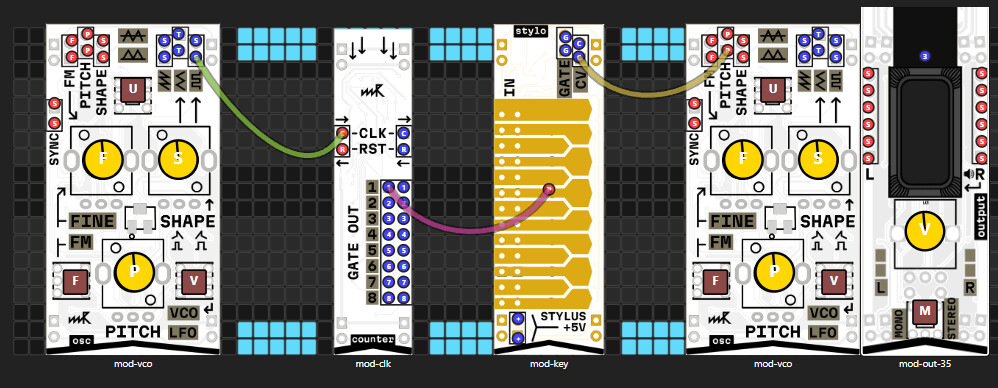
I dunno if this is a quirk of the particular modules or if it’s how something like this would work in other designs (I don’t have a stylus-like module), but…
When patching above, if I run gates 1-8 out to the individual key pins, I can get it to function like an 8-step quantized sequencer. HOWEVER, if I skip one of the gates, it kills the sequence straight through. For example, if I put patch gates 1, 2, 3, 6, 7, 8, it plays 1,2,3 then holds on 3 until it restarts.
I figured it’d either hold 3 for those two notes or play nothing, then pick back up.
Any input would be appreciated.
Did you patch all steps into different keys?
I wanna reproduce your setup in my hand and check, by your description it looks not as it ought to be
I did, but the tool doesn’t support showing that. Just an arbitrary sequence of gate 1,2,3 to random pins on the key, then 6, 7, 8 on others. Could theoretically reuse keys. As long as you skip gates on the counter.
Thing is that I left 4 & 5 open. I initially tried it with 1, 2, 3, 5, 7, 8 so that it’d skip 4 & 6 (or make 3 and 5 stretch) and it did the same. After 3, it just kept playing 3.
You’ve found interesting bug, thank you!
I reproduced it yesterday, after you connect 3 adjacent pins somewhere it starts skipping another steps. I need to go deeper in research what happens in there.
1 Like
It doesn’t have to be 3 adjacent pins. Any number of pins greater than 3 cause it to require sequential gates.
I tested with every-other (1,3,5,7 & 2,4,6,8) pin sequences on the counter with matching pattern on the stylus and it repeated the issue.
I noticed that the gate light doesn’t seem to light up when the bug occurs. I also realized that the stylus touch-pads can cause it to work as one would expect (though that is just workaround).
I tried to reproduce this and observed that the gate output of the stylus keyboard did not activate if there were more than three connections from the clock divider to the keyboard.
Almost as if the low outputs of the inactive steps with their majority suffocated the single high output.
Except, there is a diode at every output, so the low outputs can not carry current.
Except those are Schottky diodes with (possibly) a non-negligible reverse leakage current, and the current around key_bias in the keyboard module is pretty low.
So maybe using normal diodes instead of Schottky ones would help (the low forward voltage drop of Schottky diodes is probably not needed here). Or just making some wires with diodes (1N4148 or something) in the middle…
2 Likes
Thanks for your deep research!
I will try to put non-schottky diodes between clock and keyboard to prove idea about leakage
2 Likes