Stylus keyboard that outputs CV/Gate signals.
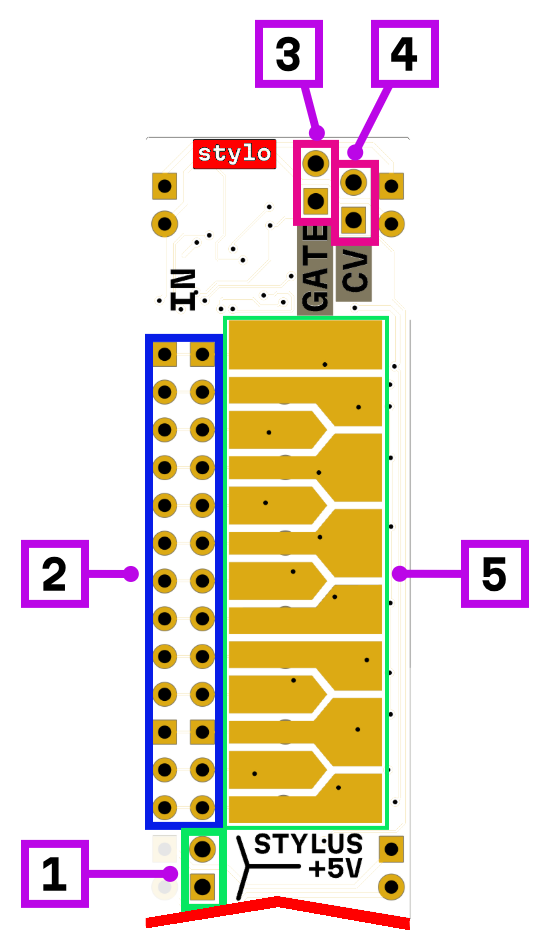
Connect an alligator clip wire or male-female jumper to the +5V pins. Now you can play: touching the keyboard pads outputs a Gate signal (5V) and a 1 V/oct CV signal (0V for the first C note, 1V for the last C note). The CV signal remains constant between key presses.
Each pad is also connected to pins, allowing you to connect external gate/trigger sources to activate notes as if you were playing them by hand.
 Documentation: modules — stylus keyboard
 Product page: microrack — Stylus keyboard
2 Likes
Might be an idea to add some relevant low cost utility modules to the keyboard to take up some real estate so the keyboard can be placed in the system with the keyboard landscape. Could also be an idea to come up with an adaptor to enable users to stack modules in a landscape configuration similar to a 1u-3u/3u-1u adapter for eurorack.
4 Likes
The gate signal path could use a logic gate or something to make the output snappy.
I’m driving the stylo via diodes from the clock divider, which works well for pitch control, but the gate output is not able to trigger the envelope (in A/D mode). When I play the stylo manually (with the alligator clip this time  ) everything works.
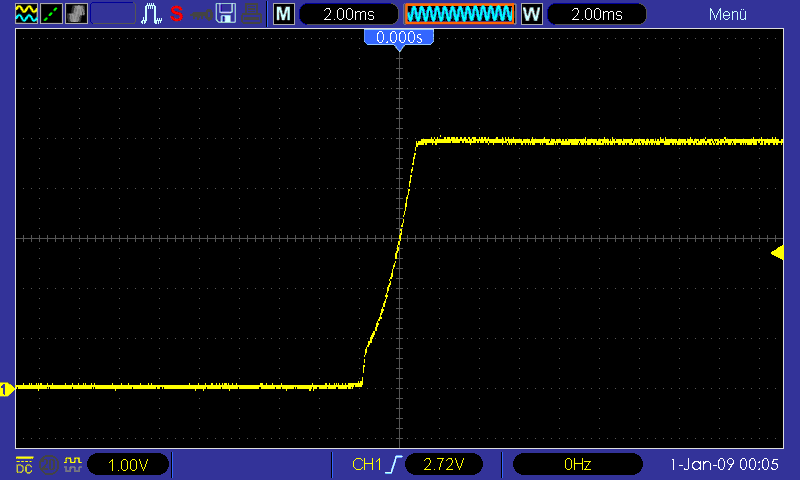
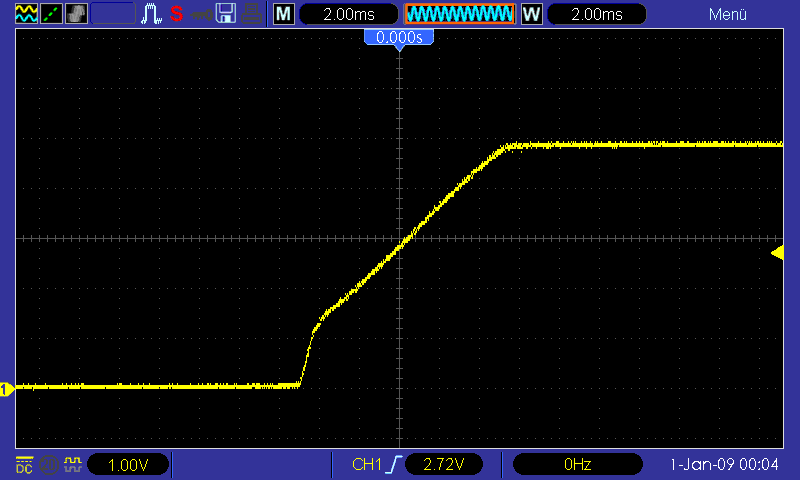
The oscilloscope shows why: The first image is the gate output of the stylo played manually. The gate output reaches 5V in 3ms. The second image shows the situation when driven by the clock divider. Now it takes 10ms, which seems to be too slow for the envelope input, at least in A/D mode, where the input goes through a highpass (C2/C3 and R49) and then needs to trigger the schmitt-trigger input of a logic gate.
The quick solution for me was to use one half of a CD4093 as two inverters (with schmitt-trigger inputs) to “sharpen” the gate signal.
Edit: One could also blame the envelope module instead. Its input could be considered analog (as it works that way in sustain mode) and therefore has to accept arbitrarily slow signals. So the part (anything with a schmitt-trigger input) that makes the gate signal “snappy” enough should go into the A/D trigger path of the envelope module.
And: I still have no idea, why exactly then gate signal is slower when triggered by the clock divider.
2 Likes